Sunday, January 31, 2016

The Real Reason

From the very beginning of creation, God has expressed his love for us.

Gen 1:27 So God created man in His own image; in the image of God He created him; male and female He created them. 28 Then God blessed them, and God said to them, “Be fruitful and multiply; fill the earth and subdue it; have dominion over the fish of the sea, over the birds of the air, and over every living thing that moves on the earth.”
29 And God said, “See, I have given you every herb that yields seed which is on the face of all the earth, and every tree whose fruit yields seed; to you it shall be for food. 30 Also, to every beast of the earth, to every bird of the air, and to everything that creeps on the earth, in which there is life, I have given every green herb for food”; and it was so. 31 Then God saw everything that He had made, and indeed it was very good.

 The creation was made for us.  The story of the Bible is God’s love for us.  But we have been deceived.  The serpent in the garden didn’t just tempt Adam and Eve with fruit, but tempted them to be free of their relationship and dependence on God.

Gen 3:4 Then the serpent said to the woman, “You will not surely die. 5 For God knows that in the day you eat of it your eyes will be opened, and you will be like God, knowing good and evil.”


It might be easy to say the rest is history.   But in a sense it is true, the idea that man can live without a relationship with God, is sin.  It is rebellion against the gift of life that he gives us.  We cannot in ourselves provide penance for our rebellion, since that would be turning the tables on God and saying sorry for our rebellion, we can fix this without you.   That’s not possible.  So not only did God give us life and all of creation, but he also gave us his son Jesus Christ.  Christ paid the price for our rebellion on the cross.

So what does this have to do with the refugee crisis?  If I accept and believe all of the above, then God has made my life possible, given me many blessing in friends, family and health.  But most of all he has given me His love, he has given me my salvation and he has given me His Holy Spirit that lives within me and strengthens me in all that I do. 

So what do I do with all that God has done for me?  He calls me first of all to love him and secondly to love others.  This love for others should be the hallmark of all who follow Christ.  Who are the others?  The good news is for everyone.

Luke 2:10 But the angel said to them, “Do not be afraid. I bring you good news that will cause great joy for all the people.

The good news needs to overcome political prejudices, to overcome cultural prejudices, to overcome racial prejudices and to overcome religious prejudices.  Jesus reached out to the Samaritan woman that crossed religious and cultural barriers.  This shocked the woman.


John 4:9 The Samaritan woman said to him, “You are a Jew and I am a Samaritan woman. How can you ask me for a drink?” (For Jews do not associate with Samaritans).

People from Syria, Afghanistan and refugees from other countries need to hear the good news of God’s love.   How will they hear this good news? They will hear the Gospel only through the action of Christians reaching out during their time of need.  Jesus didn’t just preach, he healed, he listened and he met physical needs.  He showed compassion and he spoke the truth direct and with authority.

How can we say we follow and love God, when we segregate and separate those who are unsaved by groups?  When we create us and them, we hurt the gospel of Jesus Christ. 


This is the real reason I am going to Lesbos.  This is the real reason I want to help.  This is the real reason I pray that I will be able to show God’s compassion.  Pray with me for these people to reconciled to the creator and one true God.

Thursday, January 28, 2016

The Story Continues

In late November I started to search the internet for organizations involved in the relief work in Lesbos.  Hardly any organization you would recognize was in operation there at that time.  A restaurant owner in Lesbos had created an organization of local businesses and people.  Another organization based in the Scandinavian countries looked interesting.  But then finally I found Operation Mobilization.  I was intrigued by their work and it’s alignment to my faith.  Here is a key video from that organization.

In early December I couldn’t shake the call from God to go.  I started to mention this to some of my family members and close brothers and sisters in Christ.  I had not stated I would go, but that I was thinking about it.  One morning I was having breakfast with one of my Christian brothers.  Again I was sharing what was in my heart.  He said “So are you going to go”.  I told him “I guess I am”.  I knew at that point the decision had been made.
The process of applying, getting references, updating my passport and so forth took a lot longer than I thought, but finally last week the process for approval was completed for February 29 – March 14 (plus a couple of days travel).

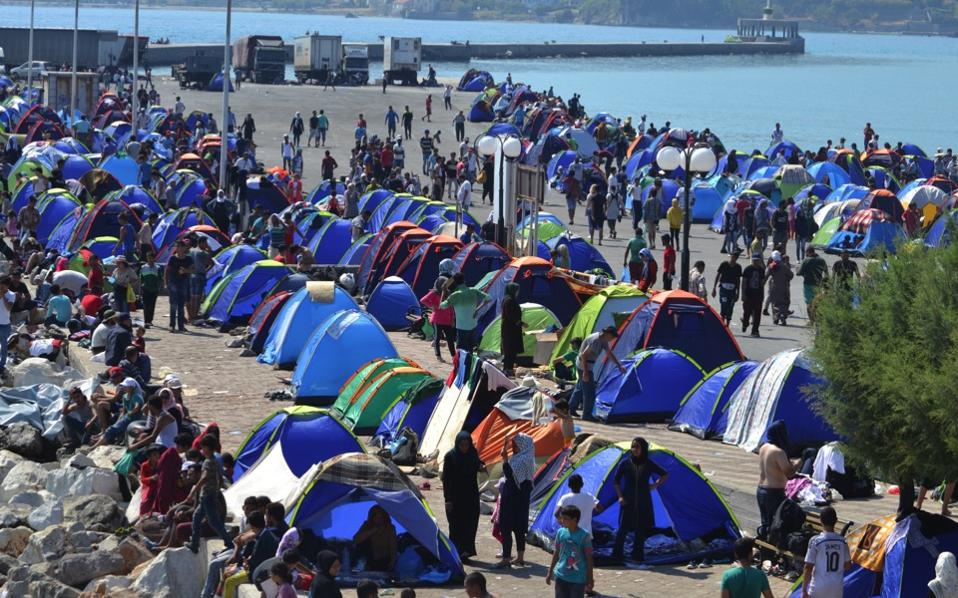
More than anything, I hope you understand that this is about people.  People that have been displaced by war.  Almost daily there are stories from Lesbos.    Here is another story of families separated.

If you have read this far, I have a couple of favors to ask of you.

Please watch the link through to the end.

Next please pray for my plans coming together for my trip and pray while I am over there.  Please pray for folks I will meet.

Please don't feel an obligation to give.  However some of you have expressed that interest and God is leading you to help with support.  So I want to give you that opportunity to participate in the work through your giving.

Support:       o   Online – https://my.omusa.org/OM-Missionary-Search  use the COMMENTS BOX, not find a missionary box  in the comment box enter my name Keith Stackhouse OM1000693872
                     o   Check – Payable to OM USA and mailed to OM USA Finance Dept. PO Box 444 Tyrone, GA 30290

Thank you for reading this post, please feel free to comment.


Sunday, January 24, 2016

The News Stories

Grisly Discovery in Migrant Crisis Shocks Europe

Aylan’s story: How desperation left a 3-year-old boy washed up on a Turkish beach

The above stories really struck a chord in me as I thought about the desperation of the families that were involved.  These stories and similar ones in early September, along with the extent of the crisis initially got my attention. Especially since this is being considered one of the largest refugee migrations in modern times.  I wasn’t thinking about me and what could I do.  I was just following the news. We think the world is a comfortable place and that peace and progress will be the solution to man’s problems, but I knew that wasn’t the case.  For much of the world their isn't peace but the fallout of nations in strife and geopolitical posturing. 

Some of the stories I was looking at mentioned the Greek island of Lesvos.  Having been there it piqued my interest and I googled news stories about Lesvos, since I couldn't imagine the island I had driven all over had any type of refugee activity, though I knew it was only a few miles off of the Turkish coast.  I was shocked that 1000s of refugees were arriving on the island by raft/boat every day.  Later in November the average per day would be 7,000 arriving on an island that has a population of 86,000.  I began to follow every news story about Lesvos.  The occurrence of drownings became so routine that most of them didn’t even make headlines.  Like all tragedies the consumer becomes numb and moves onto other things.


How many are aware that last Thursday 45 drowned on the way to the Greek island of Kos?

45 Migrants Drown as 2 smuggling boats sink off Greece

In the fall I began to pray for the refugees and the people who are trying to help them.  I thought and prayed that somehow I could help.  I thought about going.  I didn’t think of it in real terms.  I thought that by the time I could plan to go, that the crisis would be over, though I knew there were millions of refugees in Turkey and coming from Afghanistan I expected that the small volunteer groups already operating on the island would be replaced by larger organizations with a process to handle the situation.  When I read 7,000 a day in November, continued drownings and the families that have left everything.  I realized this was not going away.

This is why I must go to Lesvos.  Next how I made up my mind.

Saturday, January 23, 2016

In the Beginning

It all started about 1892 when Penelope Patsili was born on the island of Lesvos (sometimes called Mitilini after its largest city).  At that time the island was ruled by the Ottoman Empire (Turkish) and had been that way since 1462. 
Penelope had 9 older brothers and an older sister.  Though the island was ruled by the Ottoman Empire whose faith was Muslim, the island population including Penelope's family was Greek in culture and faith (Greek Orthodox).  

There had been attempts in the early part of the 19th century to rebel against the Turkish occupation but without success.  During the First Balkan War the island gained its freedom when it was captured by the Greek kingdom.  

Many of the young people at that time left the island because they anticipated that the peace would not last and they were proven right, as there followed the second Balkan War 1913, World War I and then the Greco-Turkish war 1919-1922.  At the end of 1922, the Greeks and Turks agreed on a population exchange where approximately 1.5 million Greeks were expelled from Asia Minor and 500,000 Turks were expelled from Greece.  This was a forced exchange. It was based not on language or ethnicity, but upon religious identity, and involved nearly all the Orthodox Christian citizens of Turkey, including its native Turkish-speaking Orthodox citizens, and most of the Muslim citizens of Greece, including its native Greek-speaking Muslim citizens.


So why is this important.  Penelope was one of the young people sent by her family in 1916 to leave the island permanently to the United States.  She sailed on the Principe Di Udine out of Napoli. 
She never had the opportunity to return to Lesvos.  In the United States, she married and had a daughter Calliope, who also never had an opportunity to visit the island of her ancestors.  I am the son of Calliope and in May of 2014 my wife and I had the opportunity to travel to Lesvos as tourists. 

And now once again the island is the focus of one of the greatest refugee migrations in recent history.  So this is a part of why I must go back.